Tuesday, September 18, 2007

Photo album

Hello. Been a while, and I'm sorry. Today I have pictures. (Click on any picture to see a larger version.)

My girlfriend went to the Red Location museum, which is a testament to the local anti-apartheid movement. Red Location was the first black township in Port Elizabeth. (For more information, go here.)

Photo Sharing and Video Hosting at Photobucket

This is the plaque that introduces you to the museum, and I just like the phrasing of the last line--". . .to portray a feeling of awkwardness, ambiguity and complexity." As a rule I'm for any exhibit that says, "We have no problem making you people feel uncomfortable."

(Note: I don't think my girlfriend would have taken pictures in the museum had there not been a shockingly frustrating situation: the power was out in some parts of the building. She was taking pictures so that the flash would hit the wall, and then she could look at the picture to see what was on there. I could not have come up with a more striking metaphor than a museum that illuminates the struggle against oppression, with the lights off.)

This next picture shows the government's official tactic of dealing with uprisings in the 70's and 80's. They’d round up organizers and well-known opponents of apartheid and "interrogate" them until they died under murky circumstances. Hundreds of bright young men were shot, stabbed or beaten to death while in the company of a number of policemen. Other prisoners conveniently fell or jumped to their deaths. Apartheid sent one generation of leaders to Robben Island, and the next to the grave.
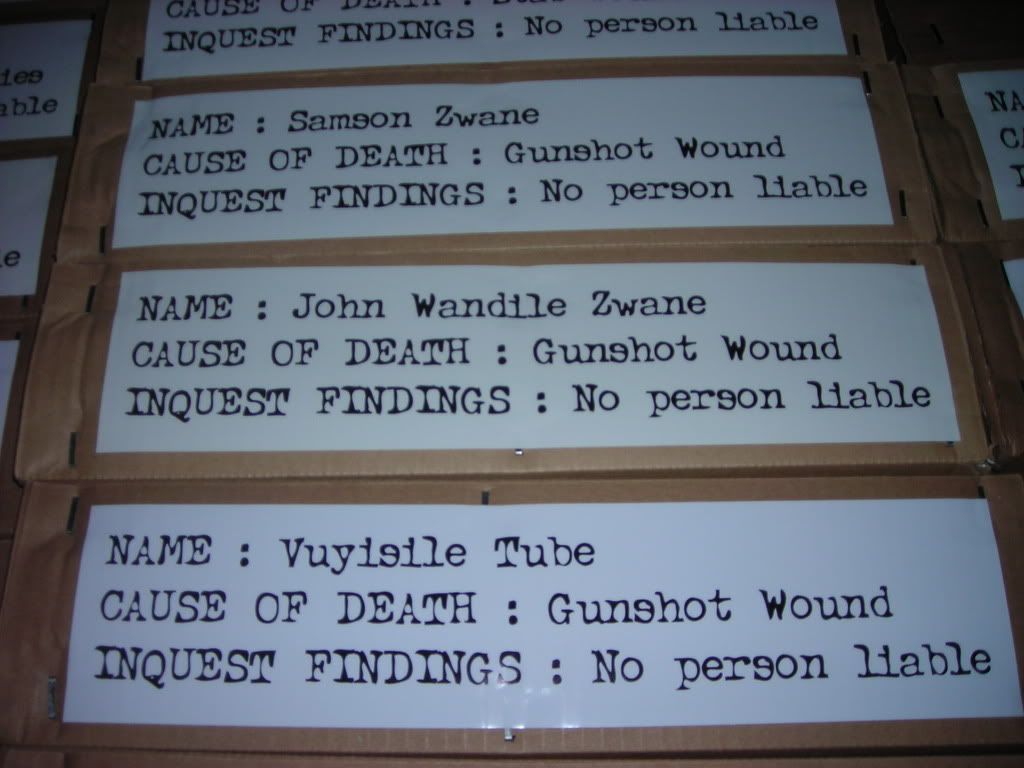
Photo Sharing and Video Hosting at Photobucket

There are a couple other pictures my girlfriend took at the Red Location, but I won't be publishing them. They were of two speakers that they had, a couple of older men who were themselves residents. I won’t put them up because I wasn't there to ask their permission. But I should mention that these two guys found time to smile and laugh with their visitors while talking about the darkest days of their country’s history. I seem to harbor more bitterness about apartheid than most of the people who lived through it. They're very forgiving. Me, not so much.

Now I'll show you the beach, which is about a five minute walk from where we live. This is the part where I confess that I don't give a damn about beaches. I just don't get it. Even Zanzibar, with its famed white beaches, holds no appeal to me. The beach part of the beach is just sand.
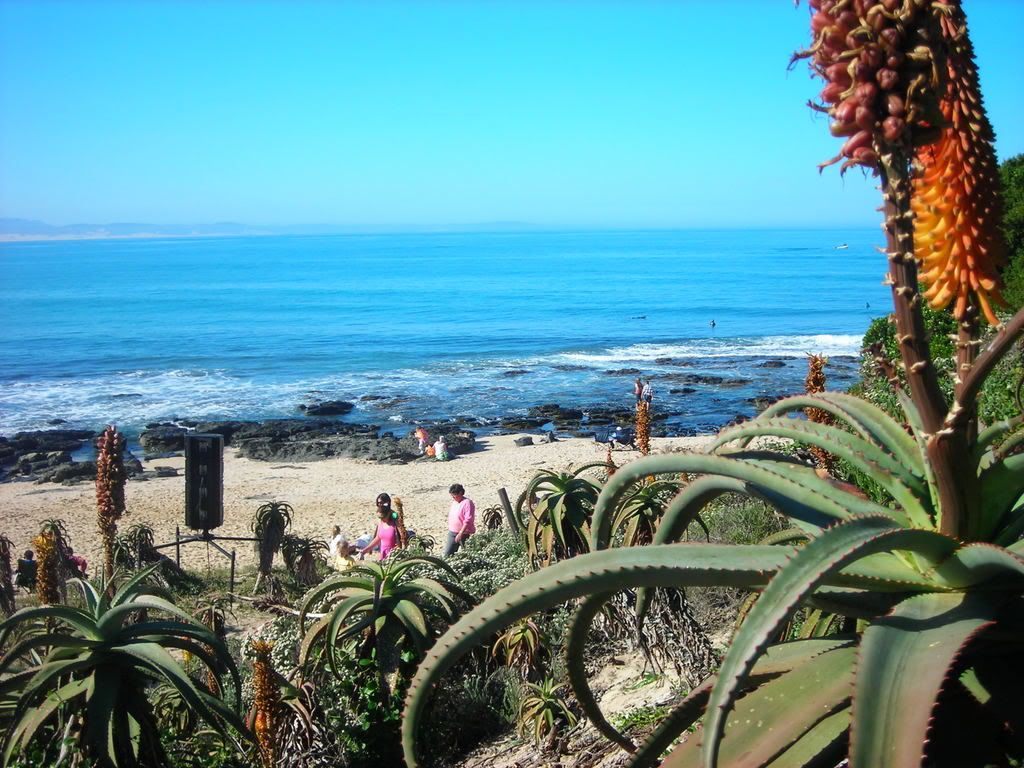
Photo Sharing and Video Hosting at Photobucket

I do understand man's fascination with water. In Port Elizabeth, you'll often catch someone lost in the oncoming waves and their own thoughts.
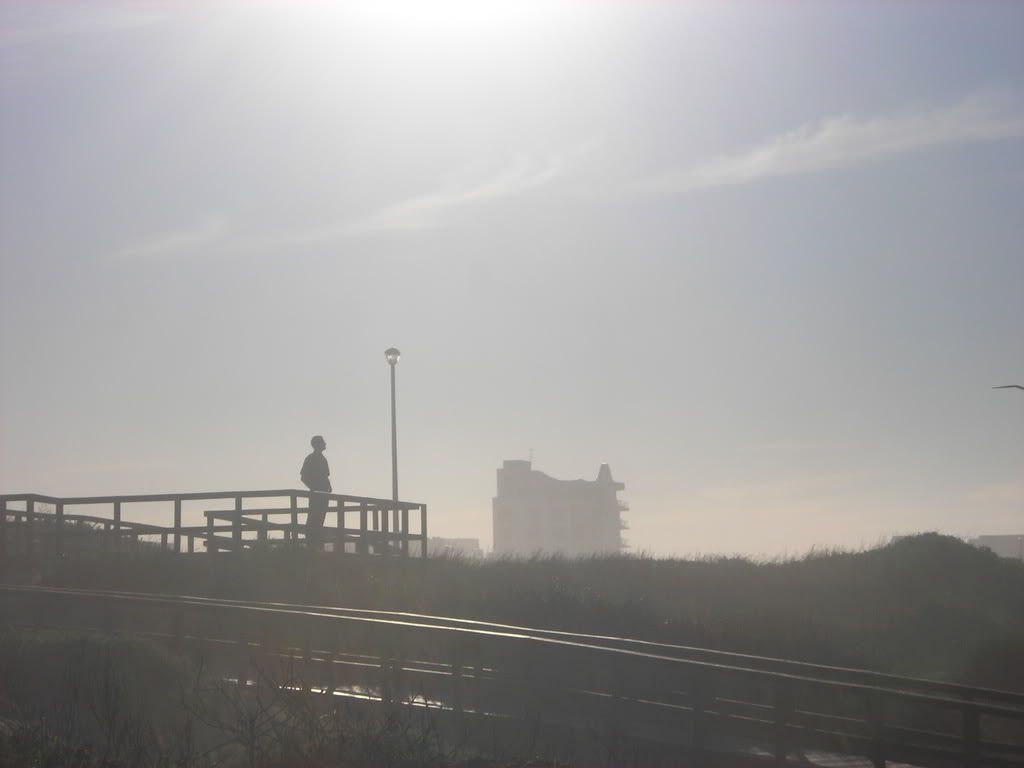
Photo Sharing and Video Hosting at Photobucket

Next, we'll look at drainage. One day when it was pouring rain, I noticed this coming up under the wall of our place, courtesy of the neighbors. How thoughtful.
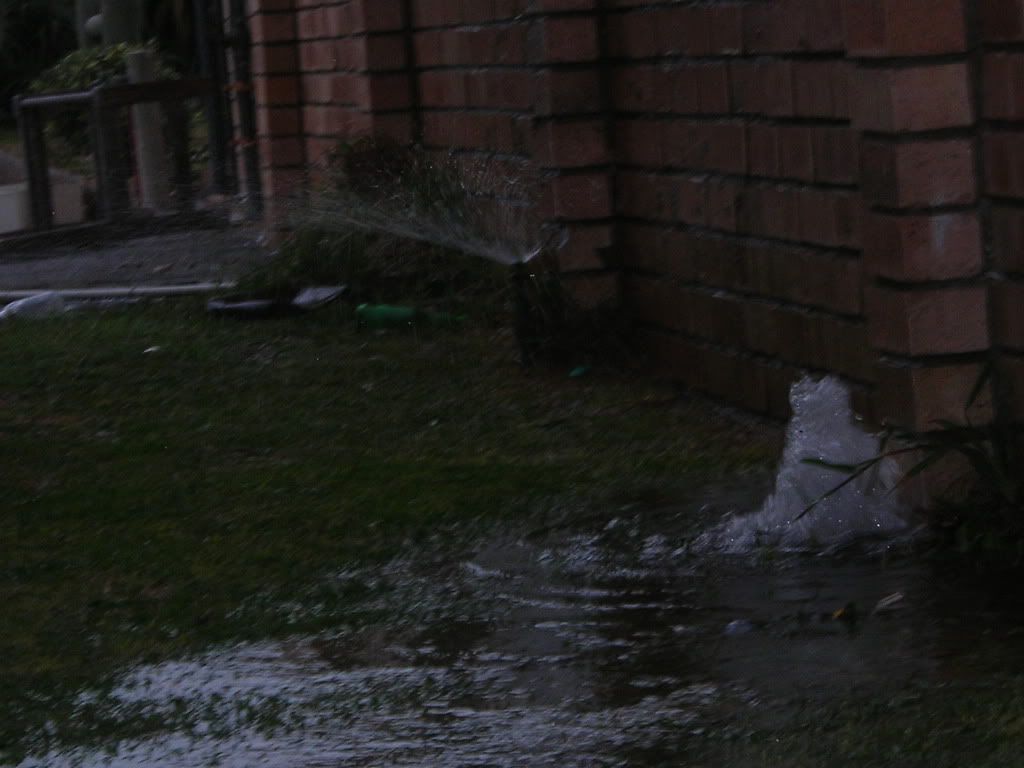
Photo Sharing and Video Hosting at Photobucket

And here's a picture to illustrate my last post, where I talked about the lack of a front wall. The two guys sitting on the right were responsible for taking down the rest of the wall, before a few others joined them to rebuild it. Again, this hole was there for a month.
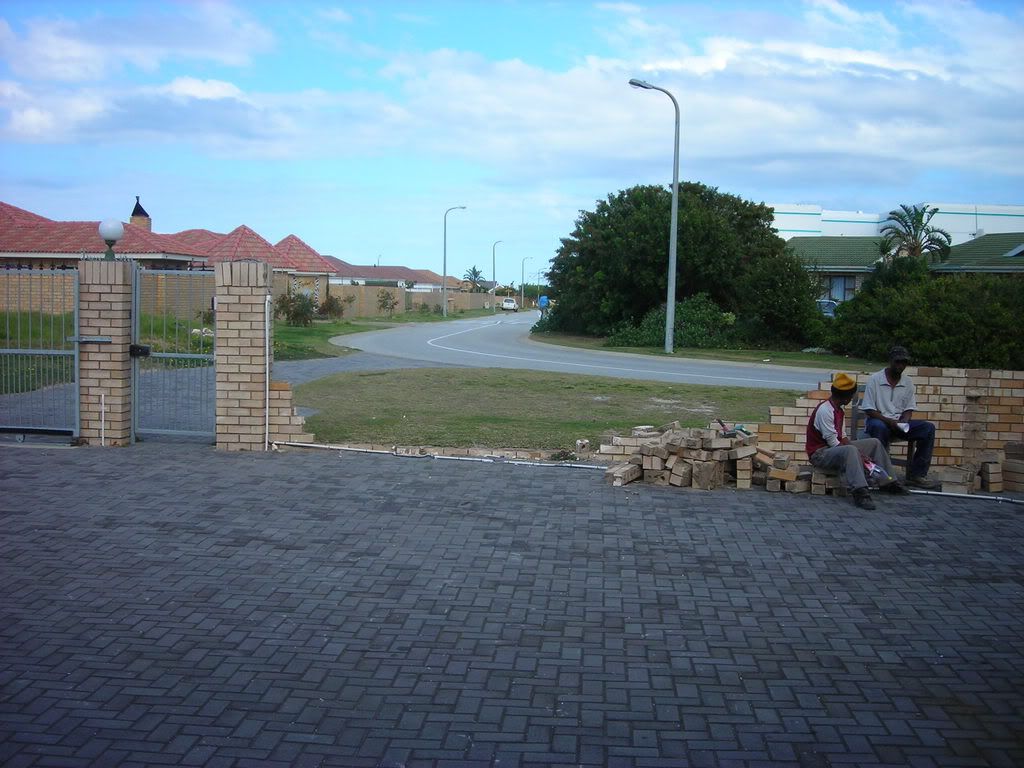
Photo Sharing and Video Hosting at Photobucket

Now, just a couple of pictures from the game drive. We’ll start with the least interesting animal, which was the sleeping rhino. Looking at a sleeping rhino is a lot like looking at a rock. (Note: the head in this picture belongs to Sergio, another passenger on the game drive. Sergio actually took all of these pictures, except, I assume, this one. Nice kid.)
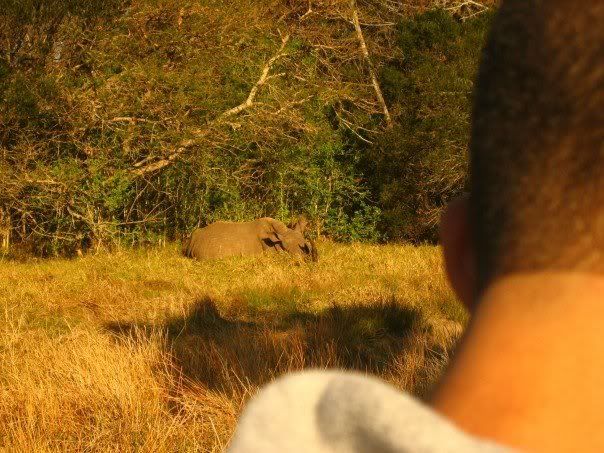
Photo Sharing and Video Hosting at Photobucket


Next we’ll see the immeasurably goofy ostrich. This odd bird came walking right up to the truck, where it became fascinated by our guide’s car keys. With its curious eye, craning neck and frazzled hair, it seems to be the nosy-old-lady neighbor of the animal kingdom. Can’t you just imagine her asking, “How’s that boy of yours?” with a smoke hanging out of her beak?
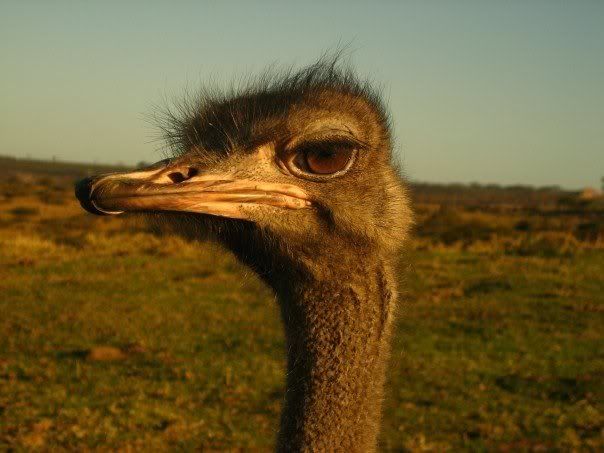
Photo Sharing and Video Hosting at Photobucket

When I first saw a giraffe close up and moving in the wild, I immediately thought of dinosaurs. I know there's no close relation between the two. They just don't look like they should still be walking around on my Earth. This one trotted down the road in front of us before ducking off into the brush.
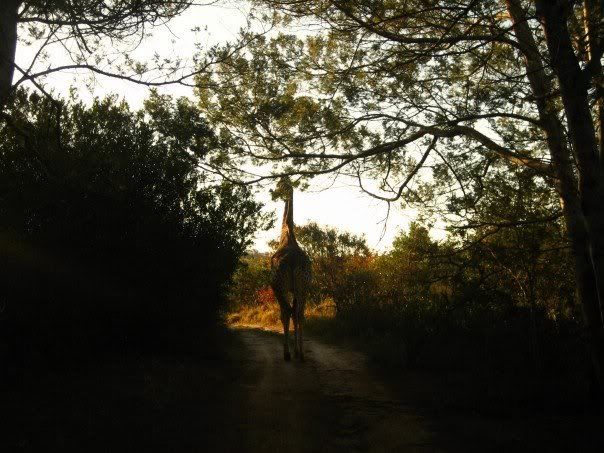
Photo Sharing and Video Hosting at Photobucket

And then, with the sun setting behind it, the giraffe took 15 seconds to remind us we weren't the only curious ones.
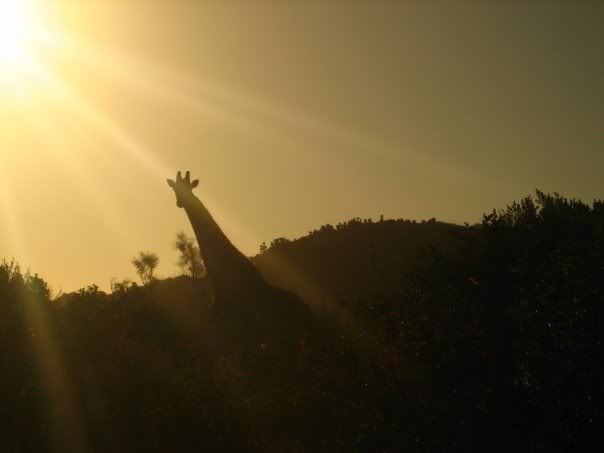
Photo Sharing and Video Hosting at Photobucket

Now the real reason to go on a game drive. Lions. The park we went to happened to have a rare white male, and on this day he was relaxing with one of the females. (You'll see in one of the pictures that she eventually decided to come check us out, probably getting within a 10 feet of the truck, at which point the guide decided to put some distance between us.)

You've seen pictures like these before. And you can look at the lions in these pictures, but you'll have to go find your own. These two are just for me. I get why Hemingway's Old Man could not get the lions out of his head.
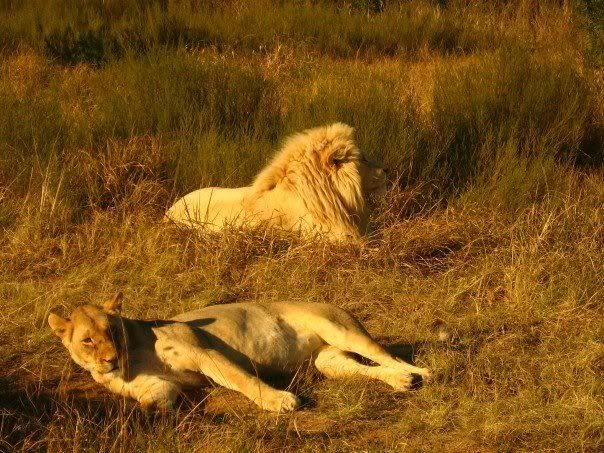
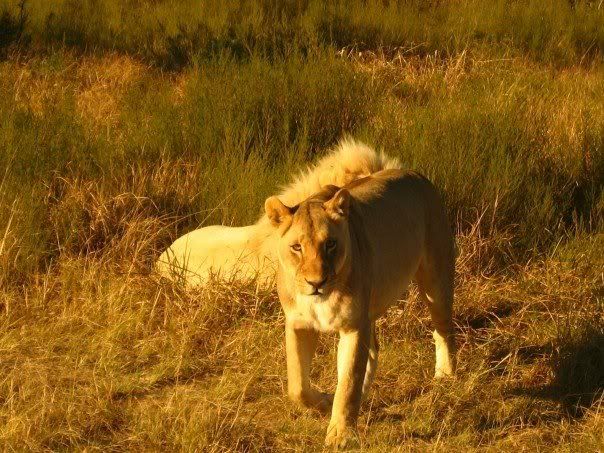
Photo Sharing and Video Hosting at Photobucket

Photo Sharing and Video Hosting at Photobucket

Photo Sharing and Video Hosting at Photobucket

Photo Sharing and Video Hosting at Photobucket

I know, I know.

- Finally, in sports, here's something that just came up on my TV screen. It's your update on South Africa in the Cricket World Cup. The score at the time was SA 154-8 Overs 20. I have no idea what that means. It looks like coordinates on a map. On the right hand of the screen, this competition was identified as the World Twenty20 Super 8. Right.

Look, what they're doing seems very athletic. It reminds me in principal of baseball. But the scoring is weird, the batter wears a beekeeper's uniform, and matches go on for six weeks. I find it highly coincidental -- if not outright suspicious -- that a sport called "cricket" has something in it called a "wicket." (There are no zolfs in golf and no clasketballs in basketball.) I can't quite say why, but this bothers me.

Also, judging by "Twenty20 Super 8," I think this tournament is taking place 13 years in the future at cheap hotels. I think I like cricket the insect more than cricket the game.

And in rugby news, rugby is awesome. Very watchable, often very hardcore. It's American football without stops and pads. Thrilling. 40 minutes, halftime, 40 minutes. No commercial breaks. I dare any American football fan not to be caught by it. In the second half, play stops every few minutes and doctors run onto the field. They seem to help six or eight players at a time, most of whom are bleeding from the head. When they show replays, the announcers say, "Let's see how exactly the rest of them didn't get hurt."

I would probably miss it at home, but South Africa is one of the most Rugby-crazed countries in the world. (Though SA's mascot, the springbok -- a dainty little deer thing -- isn’t exactly intimidating.) The overriding theme of the Rugby World Cup at this point is the dominance of the Southern Hemisphere. South Africa huge over England, Argentina over France, New Zealand crushing Italy.

And I'm sitting in a country that just made itself look like the second pick behind New Zealand, with its scary Haka pregame ritual and even scarier speed. This could get interesting for me if South Africa go deep into the tournament. Bars are going to be on fire, maybe literally if they win.

Meanwhile the cricket thing is actually here, in South Africa, and I'm not going. Well, maybe in a few days if I still can't get a good night's sleep.

That’s all. I'll write again soon.

Monday, September 3, 2007

Let go

You can't sleep.

The wind is blowing. Somewhere in the house there's a door that's not shut, and it's creaking and banging and rattling, and you might as well get up and try to get the words out.

About a month before you came here, a woman, drunk and suicidal, drove her car into a streetlight pole just down the street from the house where your girlfriend stays. Then, apparently upset to find herself still alive, she backed-up and accelerated right through the wall in front of your girlfriend's house, right up to the door, where she was stopped by the front steps.

She survives, and you assume she is arrested, though you do not know. She is not heard from again.

It took a month, but the wall's back up. Everyone's got a wall here. A month without a wall in front of your house in Port Elizabeth is a month without a front door in the States. Everyone's got a wall, and everyone's got something on top of the wall: little spikes, electrical wire, something. A lot of them have something behind the wall: hulking, ferocious guard dogs that bark at everyone they see.

The house's backyard walls have the spikes, and your neighbor has electric wire that runs above the spikes. You are completely protected from your neighbor breaking into the house.

The front wall of this house, now freshly replaced, has nothing on top of it. It's about six feet tall. Yesterday some punk kids were tossing a rugby ball around and one of them threw it over the wall. One kid, about 13, just boosted himself over the wall, grabbed the ball, and went back over it. He didn't mean any harm, but it's not making you sleep any easier.

Nor is the woman who came by earlier this day. She looked nice, and she had a clipboard. ("Normally I have a laptop," she said, oddly, more than once.) She asked your girlfriend some survey questions about radio stations or music or something.
Then there were other questions.

"How many TVs do you have in the house?"

"How many laptops?"

"What about other electronics?"

The girlfriend said, over and over, "Oh, no, we don't have any." Smart. You're stupid. You'd have said, "Oh, there's two TVs in here, but most of us watch movies on our laptops."

You can't sleep. Some house down the street had its alarm go off last night, when you couldn't sleep. A minute went by and they didn't turn it off. You remember when you heard that 99 per cent of the time home security alarms go off by homeowner error. "Not here," you think.

The alarm wailed for five minutes. Then five more, and five more after that. The homeowner is either deaf, dead, or out of town. The alarm finally stopped, and yet you were not comforted.

There was a free shuttle bus that just started to take students from around where you stay to the campus and back. It ran a few weeks. The taxi drivers--the one's you'd seen as funny characters, written about them jokingly--were not happy. A couple days ago one of them walked into the road in front of a free shuttle. When it stopped, the taxi guy crooked his finger and thumb so that they looked like a gun, and pointed at the driver. The free shuttles stopped running.

You can't sleep because a couple weeks ago, when you and the girl were off on your little safari trip, some guys walked through the non-wall in front of the house and took a baseball bat to one of the girl's windows. Then they left. They were probably just drunk kids, vandals, though you don't know. They are not heard from again.

Another alarm goes off tonight, somewhere down the block. This one stops after just a minute, and you wonder what that means.

Wind whips against the house. The birds make the most haunting noises here, and light raindrops can sound so much like footsteps.

. . .

You try to let go.

There's not much difference, really, when you look close. You drive through an all-black part of East London and you look close. The old men sit down and look tired, and one lights the other's cigarette. The young guys stand on corners and stare at you over their shoulders and try to look hard. The girls show a mile of leg and laugh, hard. You've seen all this, more or less.

You try to let go of "normal." First world, third world, the developing world. . . There is no juxtaposition, just position.

The BMW drives by the goat farmer who lives in a little aluminum rectangle. And maybe the driver thinks "Poor bastard," and the goat farmer thinks, "Rich bastard." Or maybe the driver thinks, "I wish it were that simple," and maybe the farmer thinks "I'd rather have a Lexus."

Maybe you just think too damn much and they're both thinking the same thing: "Beautiful day, inn'it?"

Let go.

Let go of the fact that the best piece of local nonfiction you've read since you got here was a stunner of an essay in the Sunday Times by a journalist who's paranoid because a few years ago someone showed up at his bedroom window and shot at him and his wife. And he was a local, a native, a lifer here.

Could you really--do you really think that, as you've said a number of times in your own head and maybe even once out loud--do you really think you could move here?

Yes, you think you could, and you think you could let go.

You can't sleep because there's something blowing in your head, and it'll keep banging and rattling until you get up and get the words out.

Tuesday, August 21, 2007

Dead ends on the way out

Hello.

I've been in South Africa almost two weeks now. My only real problem is that I can't sleep.

But then, I couldn't sleep a full night in the U.S., either. And if I slept well at night I'd probably have nothing to wake up and write about. So I can't complain.

I had meant this entry to be a compilation of pictures with humorous captions, but my girlfriends camera has gone ill. Its only working function right now is a buzzing noise. Well get it repaired. The pictures will be up some time this week. Until then, a few observations:

1. The first thing you notice about Port Elizabeth is the wind. It's incredible. And this is coming from someone who lived the majority of his life in North Dakota and Minnesota, where there's nothing tall enough to stop the stuff ripping down from Canada.

At night in Port Elizabeth, you can lie in bed and listen to the entire outside of your house turned into a whistle. And when you're walking outside during the day, the noise of it whipping against your ears is deafening. You have to yell at the person walking next to you, and then you have to watch their lips while they talk. I'll need a hearing aid by November.

2. The second thing is the speed of life. No one's in too much of a hurry to do much of anything, except for us damn Americans, who can often be spotted passing the locals walking along the roadside. Here's a good example of the relaxed South African pace: the word "now" does not mean now. As in, "I'll be with you now," which means, "I'll be with you in a moment." Then there’s "now now," which is the extended phrase: "I'll be there now now," is more like, "Give me five minutes."

And just to mention another phrase that is uniquely African: When someone says something in the U.S. that you didn’t expect or that you want them to expand upon, you’d say, "Really?"--admittedly, not too clever. Here though, they ask, "Is it?" I assume this is shorthand for "Is it true?" I'll get used to it. But the first time I heard it from an otherwise highly intelligent person who has been speaking English since birth I wanted to say, "There's been an accident--get this man to a hospital!"

3. The third thing you notice about Port Elizabeth is the exchange rate. American money goes a long way here. A few South Africans have told my girlfriend, "Go back to the U.S., work for three years. Then come back and buy a house." Needless to say, it's being considered.

4. The fourth thing you notice about Port Elizabeth is the wind. Wait, did I already talk about the wind? WHAT? OKAY!

5. The fifth thing is a sad one: they play awful American music here. Just like in America.

6. The sixth thing that you notice as an American in South Africa is the faucets. Hot and cold water come out of separate taps. So if you don't want third degree burns or frostbite, you have to somehow make two streams of water that are four inches apart become one. I think anyone who can do this has magical powers, and should immediately be named President Mbeki's Minister of Health.

7. The seventh thing you notice are the taxis. There are "cabs," which we Americans would call "taxis," and then there are "taxis," which are more like shuttles. They look like they seat about eight or nine, but if you watch them load or unload you’ll see something similar to the clown car act at the circus. They zoom around one right after the other, and if you can stand the risk of sitting next to someone who smells like last Thursday, you can get most places in the city for less than 10 rand (about $1.25 U.S.).

As the taxis roll upon the endless stream of roadside walkers–-and count this lazy American among them-–they leave no ambiguity about their presence. The driver honks, and his partner, leaning his head out the window, yells "TOWN!" at everyone they pass. (I’m sure the driver thinks, "Why is he shouting? Can't he see that I'm honking?" And the partner thinks, "Why am I shouting?") They don't discriminate, either: say a taxi's going west, and someone is walking east--this minor detail does not stop the taxi from trying to lure them in for the ride.

I can't imagine the success rate on that kind of attempt is very high. I'm not sure many people think, "Well, I was going home. But those guys seem to be having a lot of fun. I'll go that way instead." I'll learn to drown these characters out now now, but for the moment they’re a nuisance. Besides, they drive on the left side of the road, which seems incredibly dangerous.

Okay, that's enough for now. I'll leave you with a letter I've written to Fred Khumalo, a columnist for the excellent Sunday Times, which is based out of Johannesburg.

Mr. Khumalo, whom I know to be sharply-dressed from the enormous picture at the head of the "Fred Khumalo Page" in last Sunday's times, has written a column about the bus tours that pass through the various townships. You can find it here. I’d ask that you read it before reading my response, if only to give some context.

As Mr. Khumalo's "MAILBAG" feature runs only a thin column down the left side of the "Fred Khumalo Page," I've decided to run my letter here, in full.


Mr. Khumalo -

I am a visiting American. I arrived only about 10 days ago, and I'm staying in your country for three months. I read with some interest your column about the bus tours that take visitors through the townships of South Africa.

I'll admit that I was a bit squeamish when I first heard about these tours. I thought, as your column alleges, that they sounded exploitative. Indeed, I first imagined zoo-like tourism destinations. ("Have you been to Coffee Bay? Oh, and you must go see the Sowetans.")

But now that I’ve been to the Walmer township in Port Elizabeth--where I'll be volunteering with an after-school program for young kids--I've changed my mind. Sure, I was made uneasy when a man in his 20s stopped working on his car to glare at me as I got out of the van. But that went away when a dozen kids surrounded myself, my girlfriend and another companion. They were full of questions. They wanted us to play with them. A couple of them just hugged and said nothing.

I cringed when I read your words about the animal attacks at game reserves. I get the comparison you're trying to make. But to me, it fails.

You see, I've also just been on a game drive. And I have to make a few points.

- The animals do not see a group of human tourists when the 4 x 4 rolls up alongside of them. They see a single, huge animal. So they don't feel exploited, they don't feel intruded upon. They just think, "There's that elephant-like thing." And, thusly, they are almost indifferent toward it. We sat about five meters from a pair of lions, and the big male didn't even stand up to welcome us. A rhino slept peacefully in our presence; a giraffe shuffled along in front of us before stepping off the road, only to turn back and cast a curious glance our way.
- The animals at the game reserve seemed totally content with their lives. They eat as much as they want, they roam around as they please, and they sleep well at night knowing they are completely safe from the poachers that would otherwise be hunting them to extinction.
- The story about Lawrence Anthony, the conservationist who escaped being trampled by a bull elephant, was not a new one to me. These kind of near-misses happen all the time to naturalists, and in my experience, they say the same thing 10 times out of 10: “It was my fault. I did something stupid. God I love that animal.” Mr. Anthony was probably trying to check the elephant's health or attend to a wound or something constructive. Let's not imagine that he was standing over it, poking it with a stick.
- "Leave the animals alone," you wrote. "If you truly, truly want to understand them. . . ah, wait a minute. Why do you want to understand them in the first place?" I find this point silly, Mr. Khumalo. You see, I too, am a journalist. Younger, greener, dumber, and without the smart suit you sport in your picture--but a journalist nonetheless. And any journalist who doesn't know man's inherent curiosity to observe and understand. . . well, perhaps he should become an electrician.

Now let me tell you what stood out from my trip to the township. The first two girls I met, about six or seven years old, were bright, if a bit shy.

Then I was introduced to a young man named Bokke. Bokke was a very impressive boy, probably around 10 years old. His spelling was near-perfect. His math was better. He asked how old I was.

"I'm 21," I said.

"You were born in. . .1986," he said.

Then he asked what date I was born. July 29th, I said, and he told me he was born the third of May. Then I told him my dad was born May 5th, only, "a long time ago."

"How old is your dad?" he asked.

"He's 68," I said.

Bokke’s eyes rolled up a bit as he tried to find the numbers in his head. And then: "He was born in 1939."

All I could do was laugh out loud.

When my girlfriend told me later that Bokke was a bit of a hellraiser when he was with his friends, I realized he reminded me a bit of myself. (Only smarter, and with a cool accent.) Then I thought of all the things that could have – and in some cases, did – keep me off of a successful path in life. And I grew up white, in the center of America, with highly-educated and prosperous parents who treated me well and helped make up for my mistakes.

I know that in Bokke's case, there are a lot more dead ends on the way out of the township. I know that he has to chase down education and opportunity with more aggression than I ever have. And I decided, on my way out of the township, that I would keep in touch with Bokke as long as he returned my correspondence.

If the money from township tours goes back into the township itself, or at least funnels toward government programs that might help to make the life of the unfortunate better, I think it's worth it. If 1 or 2 of the 10 people on a township tour bus get off at the end and ask the guide, "Is there anything we can do to help?", then I think it's worth it. If 1 in 1000 passengers says, "You know, I'm a retired teacher; are there any schools around here I could volunteer at?", then I know it’s worth it.

I would be okay with certain safeguards put in place to insure the validity and the focus of these township tours that you don't like, Mr. Khumalo. I think the tour guides should have been born in the townships. I think the passengers should be allowed to get off the bus and talk to, and possibly dine with as many township residents as they care to meet.

And I think that the first time someone makes a snide comment, or someone takes a picture without asking permission, or someone takes a superior tone when talking about what they're seeing. . .

I think that person should be driven out, and dropped in the middle of Kruger Park to fend for themselves.

- Mike Mullen

Friday, August 10, 2007

A clear image. . .into my mind's eye

I've landed in Port Elizabeth, alive and jet-lagged. More jet-lagged than alive. So jet-lagged, in fact, that I'm writing this in the middle of the night. I slept a few hours to repay a bit of sleep debt, but then I awoke and rolled around for an hour or so until deciding that I had enough of an idea to put out a few words.

My flight from Washington, D.C. to Johannesburg, and the subsequent Johannesburg-Port Elizabeth flight were each remarkably unremarkable. Nice take offs, nice landings, no crying babies.

When I first boarded in D.C., I noticed that a woman, whom I would later find out was from Botswana, was sleeping in my seat. I decided I'd take the next one over, but then a nice American woman walked over and told me I was in her seat. At this point a nearby flight attendant asked to see my ticket.

"Perhaps you are mistaken; maybe you are in first class," he said, smiling, to the tired-looking boy wearing sweatpants and standing 50 rows away from first class.

I smiled back and produced a crumpled stub from my pocket, one that indicated that I belonged in the seat of the sleeping woman, who had since awakened. The flight attendant asked for her ticket, which actually gave her a seat one row back.

"Ma'am, you are in his seat. Is it okay if he takes your seat?"

She nodded. He turned to me.

"It's okay with you?"

It was, and without further incident I was in 57A.

This was my first taste of South Africa, and it was not lost on me. I know the frazzled state of airplane travel in my country, and I'm quite sure that on an American plane this kind of mix-up would have resulted in both of us being detained. I would eventually have been released, and sued the FAA, and the sleeping woman from Botswana would probably have been shackled and sent to Guantanamo for further questioning.

But here, on South African Airways? We smile and joke and switch, and it's over.

It was one of several differences I noticed on the flight alone. The most startling would come from the flight attendants: three pretty young women, and four men, three of whom I'm quite certain were not gay. I'm not saying that it's better to have pretty young women--okay, it is--or straight men serving you on a plane. It's just different.

But what was different and decidedly better was the attendants' attitude. For 15 straight hours, they smiled at passengers and laughed with each other. And they didn't laugh like the American, where's-my-Prozac, I'm-only-laughing-to-keep-from-crying kind of fake laughter. More like, "Did you see that guy in the Hawaiian shirt in 78D? He might as well wear a hat saying, 'PLEASE, TAKE MY TRAVELER'S CHECKS.' " Which I suppose is the kind of thing you can get away with when you speak a native tongue.

One of the guys was even nice when I blanked on a regional phrase. He came around with drinks and I asked for water.

"Still?"

What do you mean, 'still?' I thought. I just asked for it. I stared up at him for a second, and he realized my confusion.

"You want sparkling or still?"

Oh.

The older gentlman sitting next to me downed a miniature bottle of red wine, and I struck up a conversation. It turned out he was originally from Uruguay, but had been living in D.C. for 20 years.

We talked off-and-on for a while, and he told me he was visiting a friend outside of Johannesburg. His friend had been running a construction business for some time in South Africa.

"It's a rich country, South Africa,” he said. “You know? They have a lot of gold and diamonds."

Because there was a language problem--and of course the problem was, this fellow didn't speak my language as well as I wanted--I held back.

I would have liked to say, "Ricardo, I believe your friend has misled you. A few people, like your friend, have done very well. Many more are struggling."

Instead I smiled and, like an idiot, said, "Yeah."

It's probably best I pick my battles.

. . .

So, back on solid ground, what then?

Being greatly concerned by race relations, I was immediately alarmed when I saw a thickly-accented white South African berating a black airport employee in Johannesburg. He was jabbing his finger in the guy’s face.

"Don't you fucking smile at me!"

I was relieved when later I saw the guy giving the same business to a white employee. Apparently someone had lost his bags, and no race, color or creed would be spared his wrath.

A black gentleman was standing right in my way after I passed through customs.

"May I take your bag for you?" he asked.

I wasn't quite sure how to get to the domestic flights, and I could've used the conversation, so I accepted.

He explained to me that we had to walk outside because they were rebuilding most of the airport. I had seen this. When I looked outside my window upon landing to discover three different cranes in operation. I'm not sure the typical crane-to-person ratio, but I assumed they were doing a massive overhaul, and he confirmed this.

"They are building the underground train, too," he said. "It's all for the World Cup."

Ah, there it was. The thing that I had come here for, the thing about which I have a thousand questions, had in fact found me.

Because to me, this is the story of the 2010 World Cup. Will South Africa be ready for it? What will that look like? And most importantly, what will this country look like when the games have come and gone?

After all, if South Africa builds subways and fix roads and expand airports and do all kinds of infrastructure work that had heretofore been beyond its government's reach or desire. . . well, after the World Cup is over, all of those things will still be here.

But I’m no dope. I’ve seen my country explain the side effects of big projects, and I’m trying to get better at taking the spin off of what I hear.

I know that one part of construction means deconstruction. I know that one part of revealing South Africa's developing culture is hiding its hideous past. I know that very near to the stadium in Port Elizabeth is the city's township, where steady work is rare and crime is common, and for some people the two are one and the same. I know that these people will watch tens and hundreds of thousands of foreigners pour into their country to go watch games they could not afford to see themselves.

I know you can't erase hundreds of years of poverty and prejudice in a couple of years. It's much easier to sweep those things under the rug when company comes over.

. . .

I lay in bed for some time, trying to organize my thoughts. But they were too far apart, and I couldn't get a hold of one of them for long enough to shape it into the written word.

After some time I saw it.

Usually when I'm trying to sleep, all I can see is the inside of my eyelids. When it's dark, they're black. When the light is creeping in it's those splotchy little spots and lines that I assume are blood vessels. But occasionally, a clear image sneaks out of my consciousness and into my mind's eye.

So here, in the middle of the night: a pair of dark brown eyes.

Even without a face to put them on, I knew they were the eyes of a child. I have no explanation for what they hell they were doing there. But I know where I can find them.

Somewhere in Port Elizabeth's township, or somewhere in the afterschool volunteer program, or on some street--perhaps as in this occurrence, when I'm not looking for them--I'll see those eyes again. Maybe I'll see them everywhere.

And that is where my story begins. Anyone who saw those eyes and didn't understand what they had to do with the 2010 World Cup is either a sports-obsessed creep or an insensitive jackass.

The question is not what those eyes, what this child means to the World Cup. The question is what might this World Cup mean to the child.

Wednesday, August 1, 2007

A bridge fell into a river

I'll be in Boston on Friday, and in South Africa next week. So I'm moving everything into storage. Every -- single -- thing.

I spent the entire day moving boxes, washing dishes, sorting clothes, and sighing. Around 5:00 p.m. I was ready to deliver a load at the storage unit my sister had picked out. I drove, following her directions, through stop-and-go traffic.

But after I took the exit, the storage place was not immediately visible. After a minute I saw a sign off in the distance -- not at all where she'd said it would be. I drove to it, and pulled up to the electronic gate. I typed in the numbers she'd given me.

CODE NOT VALID. I tried again. CODE NOT VALID. Well, she's dyslexic, maybe she mixed up that 1 with a 5; CODE NOT VALID.

With no cell phone, and with the office closed, I drove away. You can imagine the thoughts running through my head at this point, and every one of them contained a word I wouldn't say in front of my grandmother.

On my way back toward the highway, a sign caught my eye. STORAGE, it says -- right about where she'd said it would be. I must've driven right by it.

I pulled in. The code worked, and I pulled around to my spot. I went up to my door and used the key on the lock. But I couldn't open the door. It doesn't pull out, and these little levers don't move left or right or up or down... I stand there, helpless. Maybe if I really pulled -- my God, is everyone who stores there stuff here 6-5, 300 pounds? It wasn't moving an inch.

Again, I was ready to leave, and you can imagine my frustration. On a whim I tried sliding the lever one last time. Success. I was in.

I piled up boxes of books and DVDs and dishes and a bag of clothes. It wasn't a lot, but it would have been annoying to have made the trip back home surrounded by this crap and with nothing to show for my evening venture.

I began the drive back, and only a minute later that a voice broke into National Public Radio.

"We've got breaking news. We have a bridge collapse in downtown Minneapolis on 35-W, at the University exit."

I'm sure you've seen the pictures, and if not you could find them easily. "Collapse" is the right word. A bridge full of cars fell into a river.

My frustration subsided.

If I had seen the storage garage right away, if I'd figured out the door, if I hadn't circled the entire compound looking for an exit. . . I'd have been on or damn close to that bridge.

I found out later that my sister had been crossed it about 10 minutes earlier.

If, if, if.

So what do you do when you've come close to something like that?

Do you think about all of the times you'd been on that bridge? Do you think about a life of bad luck with cars, a paralyzing fear of heights? Do you think about how since you were 15 you've always been 20 minutes late, for everything? Do you think about the time when everyone was talking about death, and how they might die, and you said, "You know, I've always had bad luck with cars, and I'm afraid of water..."

You think about all those things, and you look for some larger meaning. It's not there.

Instead you go out and buy ice and bourbon. You pour a drink with an unsteady hand. Then you sit down and write it out, and you hope that someday it makes more sense.

Thursday, July 26, 2007

Fresh air

It's hot and sunny here in Minneapolis. Combine that with the blacktop effect and smog, and we're having a week of low-quality air. Yesterday it was so bad the elderly were advised against strenuous activity.

I am not unaffected by this, as I live only a couple Pujols moonshots away from about a dozen factories and mills. When I've gone outside this week and the wind was low, I could feel how bad the air was.

So when the stuff outside your door's no good, where do you go to get fresh air?

. . .


Tim Donaghy, Michael Vick, Barry Bonds, the Tour de Frauds.

Where do I begin?

Nowhere. Today there's no beginning, just an ending.

I'm not going to sift through five dozen highlight tapes to decide whether "Points" Donaghy was on the take. I'm not checking to see if that dubious third quarter blocking call from a Memphis game in December was in fact a charge.

Though I'll follow it's arc, I'm not going to get lost in the minutiae of Vick's strife. If you want my initial thoughts, scroll down. That's all I've got.

I won't go into detail on why I think Bonds should retire with 754 home runs.

I won't try to understand why everyone in the entire French countryside, peasants included, begins their morning with a piping hot cup of human adrenaline.

I mean, my God, now they're telling me I can't trust Alberto Gonzales. Where will it end?

I've been up and running here at needle in the hay since March. Covered a variety of topics, and you can find them listed at the right. Sports, other stuff. About 60,000 words.

But all of this? This is too much. I wish I was angrier. I wish I could come out all fire and brimstone. I just can't bring myself to care enough.

Yesterday ESPN.com was wallpapered with scandal coverage, stories and analysis. Not long ago they had a poll question up asking whether baseball, basketball, or football was facing the worst scandal. I opted not to vote.

The real news in this world is mostly bad news. So often I turn to sports to distract myself from people's personal struggle and hardship. It's just easier for me.

And when there is scandal in sports, what then? If your distraction from the corruption of daily life is itself corrupt, where do you turn?

Where, indeed, do I find fresh air?

. . .

My girlfriend's been in South Africa a month now. I leave in a little more than a week. I'll be there three months.

I can't wait. Besides the obvious downside of that kind of distance -- miscommunication and bad connections, now only 51 cents a minute! -- it'll be nice just to have her in the room with me again. I've spent much of the last three weeks alone. I'm tired of being on the internet sports beat. I'm tired of being inside my own head. I just want to go sit somewhere with her and talk about how good the food is.

I plan to keep writing in this space, but not necessarily along the same track. I'm not sure what I'll end up writing while I'm in South Africa, though I am not without my ambitions. I do plan to immerse myself in the local soccer scene and see what comes from that.

Anyone with a good knowledge of world sports and politics would see the fallacy in looking for honesty from this game and asking for justice from this guy. But then it's a sliding scale, isn't it?

I assume that when I get back in November, two teams will be in the World Series. Steve Nash and Phoenix will be up and running. There will be half a dozen Heisman candidates, and Randy Moss will have been either great or terrible.

Sometime after I get back, it'll catch me again. I'll hear about something Gilbert Arenas said to a 76ers fan, or I'll see a college football game turn on a punt return, or Sid Crosby will grab his stick by the blade and score a slapshot with the handle just to show he can.

Until then? As the lead character said in Good Will Hunting, "I'm holding out for something better."

Right now, something better comes in a few forms for me. I'm taking a self-taught class in storytelling, I'm trying to remember genius, and I'm looking for miracles, both great and small.

I'll keep you posted.

Until then,
Mike

Wednesday, July 18, 2007

Horror at 1915 Moonlight Road

The other day I took my dog for a walk.

Like always, I took him back behind my house, and we walked along the railroad tracks. Charlie, my lab retriever-husky, likes walking back there because there are a million weeds growing for him to smell and piss on. I like walking there because it greatly limits the chances that I run into, you know, people.

We'd only been walking for a few hundred feet when I noticed Charlie drifting toward something. Out of the corner of my eye it looked like a fat, headless duck. But when I looked closer I saw that it was in fact a fish, and one of considerable size.

You'll excuse my mistake: I see a lot of dead birds on our walk, not a whole lot of dead fish. While walking the tracks, I do see the odd person -- some of them very odd -- but very few of them are carrying fishing poles. Even if you've killed off a liter of rum, I just don't think they're biting.

I pulled Charlie away before he put got near the fish, and we pressed on. After a while I decided we'd come far enough, and we turned back for home. Again we passed the fish. Strange indeed, but once I got home it was out of my mind.

. . .

By the time the first whispers came out that Michael Vick was tied to a dogfighting ring, they were no longer whispers. There are no small stories today, because everything echoes off a thousand outlets big and small. We'll wring the news out of anything that's damp, but this story had legs and would be made to walk.

From late April to early July, the story was like stones in a river: pieces hit and rippled, hit and rippled.

If those were stones in the water, then Tuesday, via the smoking gun, came the landslide -- an 18-page, 84-point indictment of Vick and three others -- and the resulting wave has buried the entire sports landscape. The only thing that compares in this year is the fallout from Lebron's 48-point masterpiece against Detroit. The year 2007 in sports may historically belong to a 48-point rise and an 84-point fall.

As soon as all of this started, I basically got the hell away from Vick, having been burned by Jason Kidd. I was not going to defend an athlete out loud or in my own mind simply because I like what he does on the field. I don't know Michael Vick. I never did.

And he's not just a benefactor in this document. He's one of the stars. He's there on the ground floor -- "and MICHEAL VICK, also known as Ookie, decided to start a venture" -- he buys the house at 1915 Moonlight Road, he got his "Bad Newz Kennels" headband, he's at fights, and most damning, he's there at the very end.

"In or about April 2007. . .and VICK executed approximately 8 dogs that did not perform well. . ."

I finished reading and leaned back in my chair. My mouth was suddenly dry. I tried to think of something to think or feel. I just felt numb.

I got up. I called my dog. We went out the back door for a walk.

I didn't even see it first. We had gone only about a hundred feet and I could smell it. That fish. Soon we were next to it, and then past it. But even when I was upwind, I couldn't get the smell out of my nose. It stunk. It would, from that point forward, be harder to ignore.

. . .

Roger Goodell made it clear early in his term as NFL comissioner that he would have no patience for wrongdoing from his players. And this came as no surprise. But much more revealing to me was that player leadership had requested harsh penalties. No more "protect your own," no more "no snitchin'." The players themselves said, "This is too much."

That all came out in February, and over the next couple of months, we saw Goodell's rough justice. And the league was served notice: no more messing around. If you're doing something, get out now, because anyone caught on the wrong side of anything is getting suspended and is losing money, or worse.

I don't think Mike Vick is a stupid guy. I think he understood the implications. And the things written in that indictment carry right through the Pacman saga. The only thing I can take away from his continued involvement with "Bad Newz Kennels" is that he didn't think he was doing anything wrong.

Do I think that some of the allegations about 1915 Moonlight Road may be embellished or remembered incorrectly or just wrong? Yes. I'm willing to listen for Vick's version. But this investigation cites at least four sources. And the number of other people listed -- construction workers, dogfight enthusiasts, friends -- who would have acquired knowledge of the operation over the six years in question makes me believe the investigators are pretty sure of what they've got.

Do I think that pitbulls are predisposed to some level of violence? Yes, in the same way that poor young men might be more predisposed to crime. But they're not gang members until somebody trains them.

Do I think that this kind of thing happens often in some parts of the South? Yes. But there was another thing that was pretty popular in the South about 40 or 50 years ago. And that thing was called widespread and violent racism. Some people let it happen, others embraced it. History has not remembered them well.

And I'm sorry I have to make this point. But earlier this year, Vick teamed up with the United Way to donate $10,000 to Virginia Tech, which had been Vick's college. (Although I'm tempted to call it his "college team.") I probably shouldn't doubt anyone giving to charity.

But just so we're clear here, this was $10,000 from a guy who signed a contract in 2005 that came with more than $30 million in bonuses. Bonuses means it's upfront. As in thanks for signing, here's your check with EIGHT zeros. This of course excludes his endorsements. And he's "teaming up" with the United Way for 10 grand? (Ten thousand dollars, by the way, is slightly less than the amount that was allegedly wagered on a single dogfight in March of 2003.)

At the moment I also can't find any evidence that Vick ever actually visited the campus of Virginia Tech after the shootings.

Perhaps he had other things on his mind. Because a short time before or after Vick made this pledge and the run-of-the-mill statement that came with it, he is alleged to have participated in killing eight pitbulls.

. . .

I was brought out of my haze by the sound of a train engine. It was coming up behind us. "C'mon, Charlie," I said, and we turned back.

He doesn't do a lot of tricks, but Charlie's a great walk. He listens to me, and he would only be interested going somewhere if I was going there too. In the year I've known him, Charlie has become completely devoted to me. And if he's devoted to me, he is consumed by his love for my girlfriend. He follows her room to room, lying outside the bathroom when she showers. He sleeps when she sleeps, and he whines to me when she's gone too long.

I've never really valued dogs as tools. It's not in my nature to train my dog to hunt or roll over. And I don't need to "show them who's boss." Charlie had a rough life before he ended up at the humane society, and that came through when he was scared of me for weeks after we brought him home. And every time he met a new adult man, Charlie winced and clung to the girlfriend.

Charlie had been beaten, undoubtedly by a man. And when we first got him, he had several marks on his nose and a ring of stitches on his elbow where his dominant brother had bitten into him. He shakes uncontrollably at the sound of thunder or fireworks, and he can't stand to be left alone for too long. At least once a night I have to wake him from his nightmares.

Needless to say, his life has left him with a meek personality. There are very few things he'd qualify to be as a dog, other than a loyal friend. He just doesn't have it in him.

". . .executed the pit bull that did not perform well. . .executed at least one dog that did not perform well. . .executed at least one. . .executed at least two. . ."

. . .

We passed the fish, one last time. I could see that it's rotted and been picked down to the bone. Soon it will be completely gone. In 10 minutes I would forget about it. But for a moment, I was downwind. And my God, the smell.

. . .

It's been hot here in Minneapolis, and if it's hot for me it's worse for Charlie.

I got him some water, and I poured him way, way too much food.